
COVID-19 shows virtual offices are “business critical”

Virtual offices have proved “business critical” during the COVID-19 pandemic, according to a newly published workplace design guide.

Rethink Design Guide, published by RIBA in 2021, includes a chapter titled ‘Workplace’ and written by Nicola Gillen.

In the chapter, the author notes how pandemics have the potential to accelerate societal and economic shifts, as societies are forced to adapt in the present and reconsider the future.

This includes the Coronavirus pandemic, which saw many different kinds of businesses from retail and leisure, to office buildings, closed down and standing empty.

Opening new channels for collaboration and remote working

The negative impacts of the COVID-19 pandemic have led to rapid evolution in working practices, particularly for those in the workforce who want more flexible working conditions.

Ms Gillen writes: “The current crisis has shown that the ability to operate virtually is not only business critical, but it also opens new channels for more equal collaboration and potentially gives access to untapped sources of talent as more employees can access work from wherever they are.

“The shift of core offices towards physical meeting and collaboration spaces could accelerate, and this would most likely continue to take place in vibrant urban centres and regional knowledge clusters.”

Her observations highlight a trend that we have discussed in our recent news articles on the Serviced Office Website, away from large central offices, and towards more regional workspaces and virtual office workers.

The future of offices in cities

A rise in virtual office working practices does not mean an end to physical premises in important business districts like London, Birmingham and Manchester.

“Large cities will most probably continue to attract employment,” Ms Gillen predicts, “but the likely acceleration of remote and flexible working will decrease the time spent in core office hubs.”

Serviced Office Company have been enabling this trend for several years already, providing joined-up workspaces including Offices in London and Manchester, as well as virtual offices from the same addresses.

This means you can have physical premises, virtual offices in Manchester and London, or a combination of the two. Correspondence can be routed through to you wherever you are, and we have meeting rooms for hire on-site if you need to meet a supplier or customer face-to-face in a professional setting.

Are virtual offices the future?

Our virtual offices in London and Manchester are a way to get a professional address and geographical telephone number, without needing to be physically located in those cities – you can even have contact details in both locations while working from a third, completely remote town or city.

While physical workplaces will not vanish overnight – and again, our serviced offices in Manchester and London cater for this need too – the Coronavirus pandemic has been a proof of concept for companies that may have been putting off a shift over to remote working.

This is a unique opportunity to make that shift as the economy opens back up again, in a climate where consumers and collaborators alike will be expecting many more businesses to operate remotely and virtually.

As we move beyond the final phases of the pandemic, Serviced Office Company will be here to support the recovery, and to enable entrepreneurs to work in the ways, and in the locations, that serve your business best.

Shared offices create a flexible, collaborative place to work

Shared and serviced offices are underpinning an emerging trend towards “space as a service”, according to research published in the journal Environment and Planning D: Society and Space.

The article ‘Coordinating office space: Digital technologies and the platformization of work’ was written by Lizzie Richardson at the Goethe-Universitaet Frankfurt am Main in Germany, and published in the April 2021 issue.

She looked at how digital technologies are allowing office work to be carried out in a more dispersed way, and how this is leading to an increase in shared office spaces where multiple businesses occupy the same premises, sometimes for relatively short periods of time.

This is all part of the notion of ‘platformization’, in which work is reorganised using technologies that support flexible working conditions – both in terms of time and location – and new levels of independence and interdependence among workers.

Extending the concept of serviced offices in the UK

Prof Dr Richardson writes that the ‘space as a service’ trend is an extension of a decades-long market for serviced offices in the UK and other countries, dating back to the 1980s.

“Whilst this by no means implies the extinction of more traditional models of office usage, space as a service aims to generate new forms of revenue from the demands for mobility of workers … and the perceived inefficiency of voluminous and long-term investment in office real estate (whether leased or owned) by larger companies,” she explains.

“From the perspective of the different business occupiers, the model provides a space equipped with all that is necessary for office activity that, equally importantly, enables these activities to take place in front of other workers.”

Shared office space enables communication not only within businesses, but with other occupiers of the same building, enhancing collaboration with like-minded entrepreneurs in the same local area.

Studying serviced offices in London and Manchester

As part of her research, Prof Dr Richardson made “short observations in 15 offices across Manchester, Cambridge and London”. She notes that the London serviced offices market in particular is well serviced and diverse.

Of the more than 660 flexible offices in London, over three quarters are described as small operators, a characteristic also found elsewhere in the country.

“In other cities, dedicated operators with a similar intermediary function also tend to be smaller companies, often with only one space,” her article observes.

Meeting demand for serviced offices in London, Manchester and Telford

At the Serviced Office Company, we respond to demand where we see it at its highest, and in addition to our serviced offices in London and Manchester, we are currently working hard on our biggest-ever development of serviced offices in Telford, at St James’ House on Central Park.

This adds to our serviced offices in London at Davenport House on Pepper Street, and our London Business Centre at Millharbour Court, both conveniently located on the Isle of Dogs.

Meanwhile in the north-west, our serviced offices in Manchester include Exchange Quay and just a few minutes’ walk away, our serviced offices in Salford Quays on neighbouring Clipper Quay – two different postcode districts separated by a matter of metres.

Serviced Office Company to open biggest-ever serviced offices in Telford

The Serviced Office Company has some exciting news – our biggest-ever new development, which should be ready for use before the end of 2021!

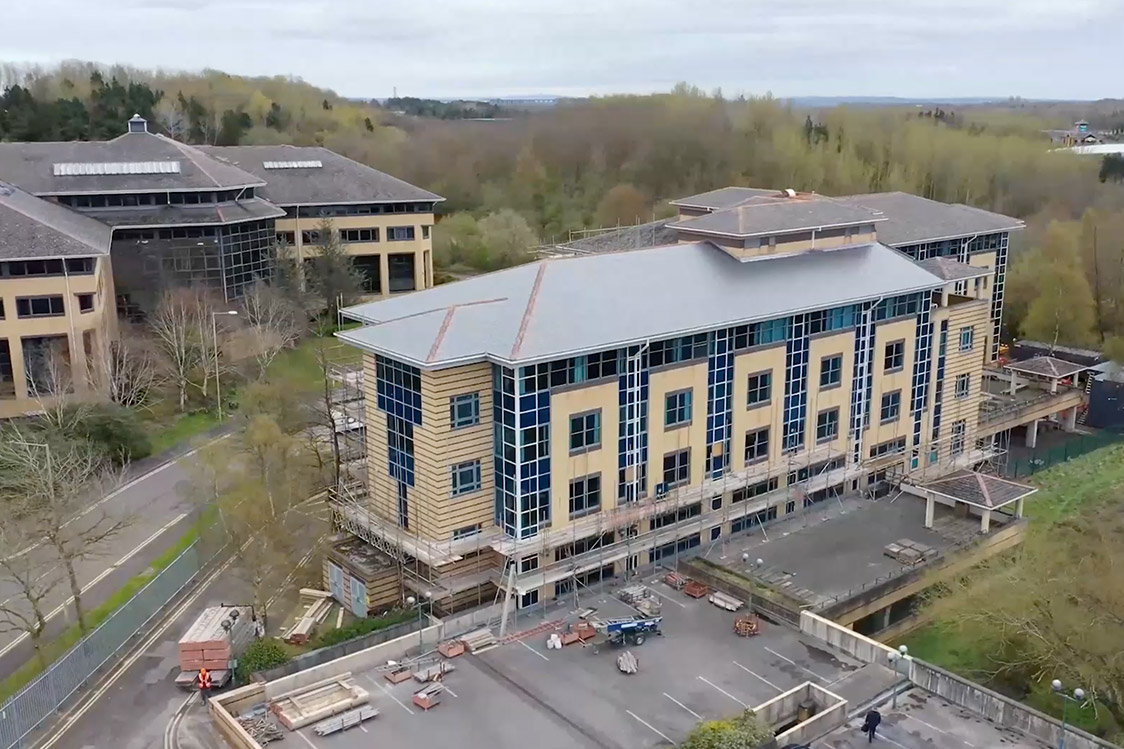
We’ve been waiting to tell you all about St James’ House on Central Park in Telford. The four-floor premises will house 52,000 square feet of serviced offices in Telford’s picturesque park, a stone’s throw from the M54.

Modus Workspace are currently refurbishing the interior to create serviced office space for small, medium and large companies, a project costing some £8 million.

By the time the work is done, we hope to offer:

  • Nearly 50 separate offices over the ground and first floors with a total of 250 desks
  • Lightning-fast internet capabilities including next-generation Wi-Fi 6
  • Heating and air conditioning controls for each office
  • Smart access systems on communal doors for 24/7 access to your office
  • Four communal areas and business lounges with kitchen facilities

We will also be offering on-site meeting rooms in Telford, including six smaller breakout rooms that can be used free of charge, and seven larger conference rooms that can be booked via an app.

What’s up top?

The top two floors of St James’ House will be dedicated to open-plan office space, which can be occupied by a single tenant or easily reconfigured to meet a range of smaller needs for SMEs.

Clients on the third floor will have exclusive use of an outdoor terrace, while occupants anywhere in the building can use two large outdoor areas on ground level.

All occupants will also be given access to a 180-space secure car park, with six dedicated Visitor bays, four electric car chargers, and a 50-space executive underground parking lot.

Rob Streetley, Commercial Director at Modus, said: “I’m pleased to be working together with the Modus team and the Serviced Office Company for their largest project to date.

“It’s gratifying to know that we were selected on a competitive basis and knowing this means they’ve put their trust in Modus to deliver. It means a lot and makes us more determined to provide an outstanding finished product that everyone can be proud of!”

About St James’ House

We’re excited to open St James’ House in December 2021. The former HMRC building is surrounded by trees on the edge of a lake and had started to succumb to nature.

The derelict interior and overgrown exterior disguised a real gem, which wasn’t helped by the fact that the site had been used to train police dogs, and had been left with police tape wrapped around parts of the building!

The Serviced Office Company commissioned Box Architects to come up with the refurb concept and we’re pleased that they will be working with Modus throughout the completion of the work.

We set a goal to get the premises ready for occupants as soon as possible, and despite ambitious work to strip out all the services and replace all the windows and curtain walling, ceilings, lifts and other interior finishes, we will keep up the pace over the next six months.

If you want to know more about our biggest-ever serviced offices in Telford, please contact us, as we’re genuinely very excited to discuss our new Business Centre between now and Christmas!

4 in 5 businesses seek premium serviced office space

Premium serviced office space is in high demand, according to research commissioned by essensys, a supplier of software-as-a-service to the flexible workspace sector.

The company’s study found that 80% of commercial premises occupiers would consider premium serviced office space to be “an attractive offering”.

Under the definition used in the research, premium serviced offices are those equipped with technology and other amenities, with flexible capacity to accommodate growing and shrinking businesses.

But despite the high level of interest from occupiers, the same study found barely more than half of landlords, 53% of those surveyed, are offering those kinds of premises.

Mark Furness, essensys founder and CEO, said: “Occupier requirements are driving demand for more flexible, experience-focused and tech-enabled workspaces and services.

“This report is a testament to the technology-led transformation that flexible real estate providers must undertake to deliver the amazing in-building experiences occupiers demand today and in the future.”

A move towards more flexible workspaces

The flexibility of serviced office space is a driving force behind many businesses’ decision to move into a shared business centre – often benefiting from improved access to collaborate with other organisations and entrepreneurs as a result.

In the essensys study, 60% of commercial premises occupiers said that they currently plan to make use of flexible workspace within the next three years.

For many, access to next-generation technology is an important element in this, and 46% said they consider this to be a key driver of occupier uptake.

The impact of the Coronavirus pandemic is also transforming the way we work, and it’s likely many more employees will embrace the potential of flexible working in the years ahead, having had an experience of it during lockdown and furlough.

Future-proof serviced offices in Manchester and London

At the Serviced Office Company we offer future-proof serviced offices in Manchester and London, and we’re always looking for ways to raise our game even further.

For example, our serviced offices come with high-speed internet and telecommunications systems powered by essensysCloud corporate-grade infrastructure.

Our premises are equipped with plasma TVs, projection screens and state of the art audiovisual facilities, to make sure every pitch, presentation and training session is given its time to shine.

You’ll find this commitment to future-proof presentation equipment in all of our meeting rooms for hire in Manchester and London, so you always have the systems you need within arm’s reach.

Find out more

To find out more about our serviced offices in Manchester and London, as well as our meeting rooms for hire and virtual office services at the same premises, please get in touch with the Serviced Office Company and we’ll be happy to help.

ICT tech is just one of the many features of our shared workspaces. Other attributes as standard range from natural daylight, to air conditioning, to comfy breakout rooms where you can escape from the stress of the day for a few minutes.

We love talking about our premises and we work hard to accommodate our clients’ needs – so if there’s something specific you would like your workplace to provide, let us know and we can take it into account.

Santander looks to local offices post-pandemic

More major businesses in the UK may look to local offices, serviced offices and collaborative spaces during the post-pandemic recovery, if they follow the strategy taken by one of the country’s largest financial services providers.

Santander have announced plans to introduce more flexible working conditions for around 5,000 staff, including a hybrid approach that combines working from home, with time spent working in “local collaboration spaces”.

The consolidation programme will see the bank left with six main offices in London, Milton Keynes, Sheffield, Belfast, Bradford and Glasgow.

In addition to these, thousands of employees will divide their time between local offices and homeworking, which Santander say reflects a desire found across their workforce over the past year.

Nathan Bostock, Santander UK CEO, said: “The pandemic has accelerated the existing trend towards greater flexible working, and our colleagues have told us this has brought significant benefits for many of them.

“At the same time, physical spaces remain very important and our sites around the UK will provide our colleagues with first-class facilities fit for the future.”

A shift towards local offices?

The plans resemble the Brooklyn model of small local offices described by Chancellor of the Exchequer Rishi Sunak in a Politico podcast in February.

He told the politics site’s Westminster Insider podcast that in the New York City borough, more people are working from small local offices in their own neighbourhood, allowing them to avoid working from their own homes, without needing to commute a long way.

Santander’s announcement is a sign that major businesses in the UK are adopting the same model as we move into the post-pandemic recovery phase, partly due to demand from employees.

As well as allowing a distributed workforce to avoid a return to early mornings and lengthy commutes, more distributed offices are a sensible measure to manage a variety of pandemic risks.

They allow fewer employees to attend the workplace at any one time, reducing the likelihood of spreading an infection.

And in the event that an individual tests positive for COVID-19, there are fewer colleagues forced to self-isolate as a safety precaution too.

An increased regional presence

One benefit of operating from multiple local offices is the ability to establish a presence in numerous different regions around the country.

Santander’s six main offices after the consolidation programme will include premises at the bank’s UK headquarters in Milton Keynes, the capital city of London, as well as Yorkshire, Scotland and Northern Ireland.

This connects with the trend of ‘north-shoring’ in which businesses look to open bases of operations outside of the south of England.

At the Serviced Office Company we are ready to support British companies who want to follow a similar strategy, with serviced offices in London and Manchester that allow you to set up in the south-east, the north-west or both.

The months ahead are uncertain but the trend is positive. If you are looking to establish a regional office structure to tap into local growth opportunities post-lockdown, contact us today to discuss our serviced offices in Manchester and London.

Stay COVID-compliant with serviced office space

Serviced offices in Manchester and London could help businesses operating in the cities to comply with the government’s COVID-19 restrictions and recommendations.

With the vaccine rollout continuing and UK infection rates relatively low, parts of the economy are opening back up – and for some people who have worked at home for much of the past year, that means heading back to the office.

Under current guidance published on GOV.UK, the government tells employers that their employees are allowed to attend a physical workplace, although where possible they should continue to work from home.

“Where people cannot work from home, employers should take steps to make their workplaces COVID-19 secure and help employees avoid busy times and routes on public transport,” the guidance adds.

The recommendations above were included in the government’s guidance as of an update on April 16th, although restrictions and guidelines are subject to change at very short notice, so employers should continue to stay abreast of any future developments.

How can serviced offices help?

Our serviced offices in Manchester and London offer a great way to get staff back to work in physical premises, rather than working from home, if you feel it is essential for your business to have an on-premises workforce.

Some of the benefits include the ability to allow small numbers of staff to return, with the flexibility to scale up in the future as the threat of the pandemic fades.

But in the immediate term, our serviced offices in Salford Quays are the perfect way to gain premises adjacent to MediaCityUK and Manchester city centre, without asking employees to face the rush hour crowds in the busiest parts of the city.

You can offer staggered shifts so staff can arrive outside of the typical rush hour times of day, as well as flexible working for those who can work from home on some days of the week.

Likewise our serviced offices in London give you a physical location on the Isle of Dogs, neighbouring Canary Wharf but with the option to avoid the crowds if you plan your journey around peak times.

Plan your post-pandemic office

Serviced offices are a great way to gain COVID-secure premises for the post-pandemic period, as restrictions and recommendations are likely to continue to change frequently and without warning, potentially for several years to come.

As the tail end of the pandemic passes, we will continue to work hard, as we have done since March 2020, to adjust to the changing guidelines and provide COVID-secure office space for all our tenants.

Our modern office interiors make good use of materials that are easy to clean and sanitise, and we will provide COVID-safe meeting rooms for hire as long as it is within the government guidelines for us to do so.

This is in addition to all the usual benefits of serviced office space, such as the ability to scale up or down in line with your business growth over time, as well as seamless integration with employees working from home.

Post-COVID downsizing sees serviced office demand surge

The predicted trend for businesses to work more from serviced offices in the post-pandemic period may be starting to emerge, according to a Birmingham-based serviced offices consultancy.

KWB Office help prospective tenants to match with available serviced office space across the West Midlands and have been saying since the start of the year that the second quarter of 2021 would be a positive time for the sector.

But director John Bryce now says the speed and scale of the upturn in demand for serviced office space has been surprising, even against those high expectations.

He adds that in the months ahead, even relatively large office-based businesses may move towards this more distributed model, supported by staff working from their own homes.

“If this momentum continues, and there’s no reason to think otherwise, I believe we’ll soon see companies which previously had 30,000 sq ft or even 40,000 sq ft looking to downsize and then use remote working – either from home or serviced offices – to create more flexible models,” he said.

Why adopt remote working post-pandemic?

March 23rd 2021 marks the one-year anniversary of the day UK employees were told to work from home if possible, as part of the first national lockdown of the Coronavirus pandemic.

Over the past 12 months, businesses have had to adapt quickly, multiple times to different guidelines, and those with smaller offices in multiple locations have had a natural advantage when it comes to putting staff into protective ‘bubbles’.

A small branch office is a natural bubble and, even if all the employees are forced to self-isolate due to a Coronavirus breakout, other offices are less likely to be affected.

With virtual offices, employees can also continue to work from home seamlessly, even if they are unable to attend the physical workplace due to self-isolation.

But why continue to adopt this practice as we move into the second half of 2021 and the vaccine roll-out reaches all UK adults?

Safeguarding the future with serviced offices

Even once everyone in the UK is vaccinated, there is still the risk of new variants of Coronavirus emerging in other countries around the world and bypassing the immunisation once they reach our population.

For the foreseeable future, it makes sense for businesses to adopt a risk-averse approach to large open workplaces, in favour of setting up smaller branch locations in serviced offices, as well as virtual offices for those who continue to work from home.

Serviced Office Company can support this, with multiple locations for our serviced offices in Manchester and London, as well as full virtual office services for correspondence forwarding and so on.

We hope businesses in the UK and abroad can get back to normal as soon as possible, with no more surprises in store, but we are also ready to adapt immediately if conditions change again before the pandemic is fully over.

If you would like to know more, contact us today, and we can help your business to take an optimistic but realistic view of the months and years that lie ahead, as we all emerge from this period of global lockdown.

Serviced offices in London take up 7% of city’s office space

London serviced offices continue to keep the city well ahead of other major business centres in Europe, new data has revealed.

Serviced offices in London now account for as much as 7% of the capital’s total office space, according to figures published recently by Statista.

The research relates to the first quarter of 2020 and was published by Statista in February 2021, based on a report by BNP Paribas.

It shows that serviced offices in London comprise the fourth-largest specified use of floor space, behind professional services, banking & finance and media tech.

And the headline figure echoes previous estimates of the London serviced office sector, which is a leading light for the whole of Europe.

UK serviced offices out in front

This is not the only recent evidence to support the suggestion that London serviced offices are performing well in comparison with other cities on the continent.

In September 2020, we reported on an article in Property Journal in which Tom Sleigh put the serviced office sector across Europe at around 2% of floor space on average.

But he noted that in the UK, the figure is significantly higher:

This new report from Statista backs up that claim for the capital, and suggests that London serviced offices may comprise even more of the city’s workspace than previously thought.

Doing more with London office space

With commercial real estate in London at a premium, it makes good sense for serviced office providers to occupy a growing percentage of the city’s workspace.

That’s because serviced offices in London allow more businesses to be based in a prime postcode like the Isle of Dogs, where the Serviced Office Company’s premises are located.

Serviced offices are an efficient use of available space:

  • Companies can occupy an office only as big as they need.
  • Multiple occupants can share access to meeting rooms in London’s CBD.
  • Further businesses can be based elsewhere using virtual offices in London.

Virtual offices in London‘s most desirable districts mean there is theoretically no limit to the number of businesses that can have a postcode and geographical telephone number in the capital.

Yet the employees are not based there physically. Instead they work remotely and any correspondence is forwarded on for attention, supporting completely flexible modes of working.

Enquire about London serviced office space

If you would like to know more about our London serviced office space, including our recently opened Business Centre in the Millennium Quarter, please get in touch and we will be happy to answer your questions.

You can contact the Serviced Office Company:

All enquiries are very welcome and we will respond to you as soon as a member of our team is available to give you a full answer to any questions you may have asked.

The growth of Brooklyn-style local serviced offices

Chancellor of the Exchequer Rishi Sunak has told Politico that small serviced offices have the potential to cut commute times and allow people to work ‘from home’ without actually being in their own home.

He told the politics site’s Westminster Insider podcast about the rise of neighbourhood serviced offices in Brooklyn in the USA, which are providing that kind of hybrid between being home-based and commuting into the office.

This supports individuals who want to reduce their commute without going fully home-based, and may also have implications for other parts of the economy such as traffic levels and local businesses within the neighbourhood.

Mr Sunak said: “A new thing that’s growing up in New York – actually, this was in Brooklyn – was a new business model of serviced offices, but in neighbourhoods, and very small. So it’s for people who are not doing the commute in, but they don’t wanna work at home when they’re doing their days at home.

“So you can leave your home and do, essentially, working in your neighbourhood rather than making the full commute into work, which is an interesting model to see whether that picks up.”

Will local serviced offices be the new normal?

‘The new normal’ is an often used term to describe what will happen after the Coronavirus pandemic ends, and particularly which of the practices picked up during lockdown will continue for the long term.

Mr Sunak tackled this too, saying: “Is it gonna come back in exactly the same way? Probably not, and actually even small changes have quite big implications, whether it’s for the economics of commuter rail or a coffee shop that’s used to servicing commuters.

“If people work one day a week on average at home and everyone does that, that’s 20% less commuting traffic. That’s not a small impact.”

Again, neighbourhood serviced offices could be the trend that allows this to happen, as businesses set up a number of small branch offices in different parts of the country, with isolated pockets of employees who live within a short distance of each branch.

How the Serviced Office Company can help

We have believed for a long time in the benefits of local serviced offices in key communities in both the north-west and south-east.

Our serviced offices in London are located adjacent to Canary Wharf, putting employees a stone’s throw from the business heart of the capital.

Up north, our serviced offices in Manchester are found on Exchange Quay and Clippers Quay, conveniently located between Manchester city centre and the ever-growing business district of Salford Quays and MediaCityUK.

All are well serviced by road and by public transport, helping to cut commute times for employees who come into the office, whether it’s for one day a week or five.

We believe firmly in the future of this neighbourhood serviced office model, with the flexibility of on-site meeting rooms for interviews and negotiations, when you need a private space to meet with an applicant, customer or stakeholder.

To find out more about how your business can adopt the Brooklyn model, contact us today and we will do our best to answer any questions you might have about our local serviced offices.